Battle between the Cyclops and the metal cloud
The InvincibleThe Battle between the Cyclops and the metal cloud is the decisive military confrontation between the Invincible’s most powerful surface machine and the distributed, seemingly mindless mechanism that dominates Regis III. It begins as a rescue and scientific mission, becomes an immense contest between force fields and self-regenerating metal swarms, and ends by overturning the human expectation that superior weapons can produce control. The Cyclops can survive the cloud and devastate the terrain around it, but neither it nor the Invincible can convert destructive power into mastery of the planet.
Causes and Background
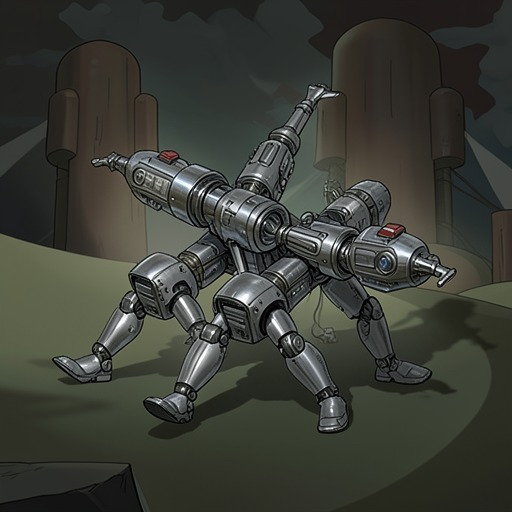
Horpach sends the Cyclops into the ravine after the expedition has suffered losses and the scientists have begun to suspect that the black “insects” are part of a planetary mechanism rather than biological life. The immediate purpose is practical: the machine is to search for missing men while collecting thousands of crystals for further examination. Horpach has consented to the expedition only after deciding that he can no longer risk human lives. The choice of vehicle therefore carries both a humanitarian and a military logic: the Cyclops is an eighty-ton automated special-purpose machine, normally reserved for intense radioactive contamination, extreme pressure, or extreme heat, and the Invincible has never previously mobilized it on a planet.
The machine is built as an almost self-contained assault platform. It carries a Dirac system for generating a force field, a spherical antimatter cannon capable of firing antiprotons in any direction or in all directions at once, a jet propeller that lets it levitate above the ground, and a telescopic inhaustor for drilling, collecting samples, and manipulating objects outside its armor. Its ceramic and vanadium hull is described as hard as diamond, while an onboard computer allows it to operate independently when communication fails. Technicians also place an automaton and prepared bunks inside it, so that any survivors it finds can be brought back. The Cyclops is thus simultaneously rescue vehicle, laboratory, shielded transport, and weapon.
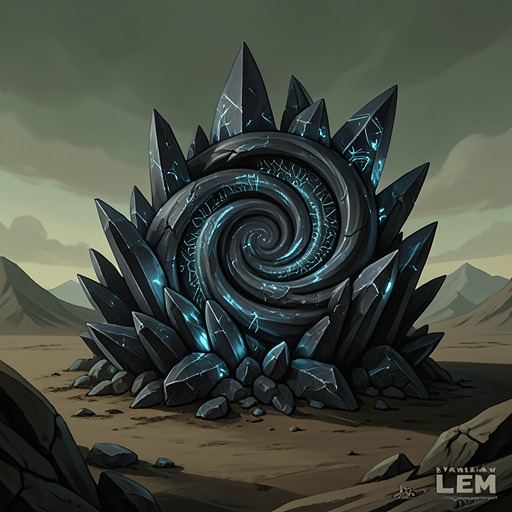
The mission takes place against a widening scientific picture of Regis III. Sedimentary strata contain ruddy-black material that appears to have a metallic, nonplanetary origin. The layers include oxidized metals, radioactive centers, and remains resembling corroded microscopic mechanisms. The disappearance of land life coincides with the appearance of these metallic deposits, although the radiation recorded is too weak and too dispersed to explain the extinction. Earlier discussion has already established that life remains in the ocean while land life vanished millions of years ago. Lauda proposes that the micromechanisms may form an “inanimate brain” when they join, separate into swarms to exploit sunlight or atmospheric discharges, and rapidly reassemble when danger appears. The battle tests that hypothesis in the most concrete possible way.
Approach and First Contact
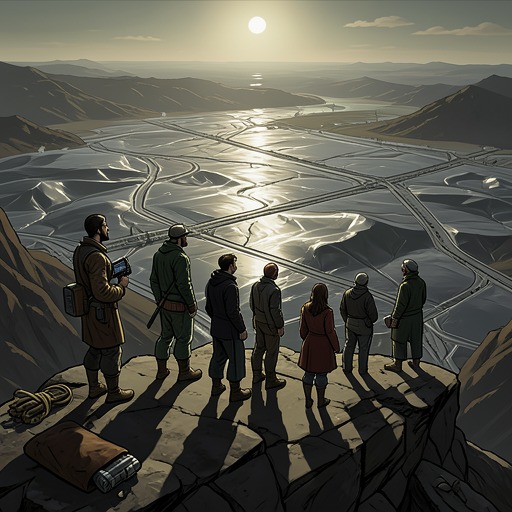
For roughly an hour, communication between the Cyclops and the bridge functions perfectly. Rohan identifies the ravine by an obelisk resembling a fallen church spire, and the machine advances through scattered boulders while its atomic drive runs so quietly that the observers can hear the stream beneath the rocks. After it enters rusting undergrowth, the signal weakens, but the computer still reports progress. A flying probe equipped with a television relay then follows the vehicle from above, giving Horpach, Rohan, and the specialist chiefs a distant view of the Cyclops moving along the ravine floor like a steel fist.
Near a gateway formed by the rock, the Cyclops stops to take a sample. It opens a narrow passage in the forward force field, extends its inhaustor, grips a clump of metallic bushes, and tears them from the ground. The sample, swarming with black insects, is stored in the hold. The action appears controlled and uneventful, but it brings the machine directly into the zone where the cloud has already attacked Rohan’s team. The expedition has not merely entered dangerous terrain; it has placed a large, concentrated source of energy and machinery inside a system that reacts to threats through sudden collective movement.
The first tactical maneuver is cautious. The Cyclops remotely switches off the Diracs protecting the farther energobot, rises above the tilted transporters, and lands beyond the gateway. At that exact moment, the surrounding scrub begins to smoke. Waves of black material rush down the slopes toward the machine, gathering with such force that the Cyclops disappears beneath what seems like a cape of tarry smoke. The cloud’s energy fields strike the Cyclops’s protective field, producing flashes and a swelling, shrinking black mass over the hidden vehicle. As more clouds stream into the ravine, the attack becomes a silent struggle between two inanimate powers: the enclosed machine and a growing swarm that has no visible commander.
The Battle and Its Escalation
The cloud eventually forms a huge whirlwind. Its base remains attached to the Cyclops’s energy bubble while its upper portion spins above the cliffs in a kilometer-wide, pale-blue maelstrom. The observers understand that the cloud is trying to break through the force field, but before Horpach can ask whether the defense will hold, the entire scene vanishes in a violent eruption. The Cyclops has activated its antimatter cannon.
The blast transforms the ravine into a landscape of fire, smoke, shattered rock, boiling water, and steam rising a mile into the air. The battle continues despite the apparent impossibility of survival. The ravine floor reaches incandescent temperatures; rock subsides into lava, and a glowing river begins moving toward the ravine entrance. The teleprobe must climb to two and a half miles to escape the violent air currents, while its monitors show burning fragments and the acoustic sensors transmit a continuous earthquake-like rumble. Even at that distance the Invincible is drawn into the event: forty miles from the epicenter, the cruiser rocks under seismic waves, nearby machines shift, and a blast of hot wind drives a wall of sand across the desert.
The decisive complication is the cloud’s scale. From higher altitude the probe reveals black streams rising from slopes, hollows, and caves across roughly forty square kilometers. The swarms consolidate in flight and pour toward the conflict, threatening to smother the Cyclops’s atomic fire through sheer replenishment. The machine reverses while continuing to shoot, perhaps because its computer calculates that collapsing cliffs could trap it even if its armor survives. Fire, smoke, remnants of the cloud, and pulverized rock become visually indistinguishable. A second antimatter burst then converts the air, debris, steam, gases, and smoke around the Cyclops into extremely hard radiation, enclosing the cloud in an annihilating zone roughly half a mile wide.
The battle’s value shift is stark. The Cyclops begins as the expedition’s guarantee that human life need not be risked, and its armor and weaponry initially seem to restore human superiority. The cloud turns that confidence into emergency observation: the observers can only watch as the machine is buried under an attack whose reserves appear inexhaustible. The weapon that should end the encounter instead enlarges it into a regional catastrophe. Technology offers survival at the level of the vehicle while making the surrounding environment more violent and less intelligible.
Apparent Victory and Immediate Consequences
After the cataclysm, the battle shifts to the plain near the ravine entrance. The cloud repeatedly surges into the fiery opening, but then the burning funnel dims as the black mass covers it. When the flame reappears, the cloud no longer attacks directly. Its edges catch fire while the main body withdraws toward the ravines. The Cyclops emerges apparently unharmed, still reversing and still firing at boulders, sand, and dunes. At last it shuts off the cannon, turns, and accelerates across the desert.
The apparent victory is immediately contaminated by uncertainty. The Cyclops does not simply return under observation; it fires at the flying probe. The observers see a filament of annihilated particles racing toward them before the image disappears and the screen turns white. The destruction of the relay severs the expedition’s view and leaves the bridge unable to determine what happened next. The machine has survived the cloud’s direct assault, but the human command network has lost the instrument through which it could verify the result. The triumph exists only as a damaged image, followed by silence.
The confrontation also exposes the limits of the strategy proposed against the cloud. Lauda argues that the mechanisms have no powerful intellect and operate from one opportunity to the next rather than according to a strategic plan. Their apparent ability to block communication, scatter when struck, regenerate from surviving parts, and migrate between regions makes them less like an army than an adaptive planetary process. Even an antimatter strike cannot annihilate all of them; destroying one continent’s population would merely drive the rest elsewhere. The Cyclops demonstrates the truth of that argument: it can defeat a local concentration, but not the system that produces and replenishes such concentrations.
Strategic and Thematic Significance
The Battle between the Cyclops and the metal cloud is not a conventional human victory over an enemy. It is a confrontation between two forms of organization: a single, extraordinarily capable machine directed by programmed intelligence, and a dispersed cloud whose collective behavior may arise from simple local connections. Lauda’s account of the cloud-brain explains why the swarm can be both unintelligent in the human sense and devastatingly effective. The cloud need not understand the Invincible’s purpose or hate its crew. It only needs to respond to danger, preserve itself, and reconfigure from surviving elements.
That distinction changes the moral meaning of the battle. The crew initially feels a “vengeful satisfaction” when the Cyclops appears to find a worthy adversary, although the narrative identifies the feeling as irrational. Later, Rohan recognizes that the humans are treating an ancient planetary equilibrium as though it were a hostile civilization capable of revenge and negotiation. He understands that humanity has not earned the grand stance of galactocentrism if that stance means merely recognizing beings who resemble humans. Its deeper meaning would be to refrain from interfering in processes that do not concern humanity—to occupy an empty place without attacking what already exists there.
The battle therefore stands at the center of the book’s ecological and technological argument. The Invincible possesses force fields, antimatter, automated vehicles, relays, and scientific analysis, yet every layer of infrastructure proves vulnerable: communication fades, probes are destroyed, machines disappear, and defensive systems constrain the people they protect. The Cyclops saves no clear expeditionary objective, secures no permanent territory, and produces no knowledge proportionate to the destruction it causes. Its spectacular endurance becomes an indictment of the assumption that greater force necessarily yields greater understanding.
Its aftermath points toward withdrawal rather than conquest. Lauda concludes that the humans should leave Regis III because the mechanisms are perfectly adapted to the planet and cannot be eliminated without destroying the world itself. The Cyclops’s local success does not refute that conclusion; it confirms it. The machine can survive a battle, scatter the cloud, and cross the desert, but the human expedition remains trapped in a conflict whose opponent is neither a government nor a mind nor a single body. The decisive consequence is not the defeat of the cloud, but the collapse of the human belief that this planet’s existence must answer to human aims.